
Introduction to Psychology Textbooks: Price, Homework, and Instructor Support Compared (2026)
Updated:
Commercially published introduction to psychology textbooks cost students $37.95 to $127.27, across nine major publishers, when online homework is included. FlatWorld’s three titles are the most affordable in that range, at $37.95 for Basic Access ($57.95 for Standard). Every FlatWorld adoption includes instructor materials, customization and a local rep.
For a digital intro psychology textbook with online homework included, a student pays $127.27 for either of King's two titles with McGraw Hill Connect, $114.99 for Myers, DeWall and Gruber's Psychology 14e with Macmillan Achieve, $96.99 for Ciccarelli and White's Psychology 7e with Pearson Revel, $78.95 for Grison, Chew and Glover's Psychology in Your Life 5e with Norton's InQuizitive bundle, and $37.95 for FlatWorld Basic Access ($57.95 for Standard).
McGraw Hill Connect, e-book and homework in one price, all three titles
mheducation.com title pages, checked September 21 and October 20, 2026
Macmillan Achieve, Myers, DeWall and Gruber's Psychology 14e, one term
macmillanlearning.com purchase panel, checked September 21 and October 20, 2026
FlatWorld Basic Access, textbook and homework, one year, three titles; Standard Access $57.95
flatworld.com Buy flow, checked September 22 and October 20, 2026
How Do the Intro Psychology Textbook Publishers Compare on Price?
Nine of the ten publishers we compared charge $37.95 to $127.27 for a commercially published digital intro psychology textbook whose price includes online homework. The tenth, Hawkes Learning, lists its software and e-book without a price. FlatWorld is the most affordable, and McGraw Hill costs the most. For open textbooks, such as those from OpenStax, Noba and Lumen Learning, see free Psych 101 textbooks. For each publisher, the table below shows the homework platform, the price of the textbook plus assignable homework, how long a student keeps access, and what the e-book costs without homework.
Full detail and sourcing for every row appears in the article text and the Sources section below.
See every FlatWorld psychology title and its price.
Which Introduction to Psychology Textbooks Are Most Widely Adopted?
No source in this comparison ranks intro psychology textbooks by adoption, but a 2025 study in Teaching of Psychology analyzes five titles the study describes as widely adopted: King’s The Science of Psychology: An Appreciative View, Myers and DeWall’s Psychology, Ciccarelli and White’s Psychology, Psychology in Your Life by Grison and Gazzaniga, and Weiten’s Psychology: Themes and Variations.
With online homework included, the current editions cost a student:
- The Science of Psychology: An Appreciative View, King (McGraw Hill): $127.27 for 180 days of Connect
- Psychology 14e, now by Myers, DeWall and Gruber (Macmillan): $114.99 for one term of Achieve
- Psychology 7e, Ciccarelli and White (Pearson): $96.99 for up to 12 months of Revel
- Psychology in Your Life 5e, now by Grison, Chew and Glover (Norton): $78.95 for 180 days, with InQuizitive and ZAPS
- Psychology: Themes and Variations 12e, Weiten and Gurung (Cengage): $127.00 for one term of MindTap
FlatWorld’s three intro psychology titles, by Frantz and Stangor, Kosslyn and Rosenberg, and Shapiro, cost $37.95 for Basic Access or $57.95 for Standard, and both packages include online homework for a year.
Does Intro Psychology Textbook Cost Affect Student Success?
Yes. In the Student PIRGs’ fall 2025 survey of more than 4,000 students at 107 campuses, 66 percent had skipped buying a textbook because of cost. Of the students who skipped, 81 percent were concerned that going without the textbook would lower their grade. More than one-third of the students (38 percent) said the cost of textbooks or access codes had affected their academic experience. Students described choosing classes by the cost of the materials, prioritizing which required materials to buy, and in some cases dropping or failing a class whose materials they could not afford.
For instructors looking to increase enrollment, retention and completion, student textbook costs should be a consideration. With online homework included, the current editions of the five intro psychology textbooks that a 2025 study describes as widely adopted cost a student $78.95 to $127.27. At $37.95 for Basic Access or $57.95 for Standard, FlatWorld’s three titles cost less than all five.
What Do APA’s Guidelines Recommend for an Intro Psychology Course?
The Introductory Psychology Initiative of the American Psychological Association (APA) keeps five content pillars on a research methods foundation: biological, cognitive, development, social and personality, and mental and physical health. APA suggests instructors “cover at least two topics from each of five domains or pillars.” The Initiative also sets out seven integrative themes, and one reads, in APA’s own words: “Psychology values diversity, promotes equity, and fosters inclusion in pursuit of a more just society.”
APA’s five pillars are broad, and any comprehensive survey textbook for the course covers all five.
The introductory psychology textbooks we compared differ in four ways: what the adoption includes for the instructor, how much setup the homework platform takes, whether the publisher posts or sends its accessibility conformance report, and what a student pays.
FlatWorld’s Introduction to Psychology v5.0, by Frantz and Stangor, includes APA’s seven integrative themes, according to its catalog page.
What Instructor Materials Are Included With Each Intro Psychology Textbook?
On the intro psychology title pages the table below cites, FlatWorld and eight of the nine competing publishers list a test bank. Top Hat’s title page lists an “Instructor Resources” section without naming its contents.
A FlatWorld adoption includes FlatWorld Homework, developed with each textbook’s authors, and SmartHelper, FlatWorld’s AI Powered Learning Assistant, which answers from the assigned textbook only and cites the passages behind each answer. Every FlatWorld package includes both, so every student in the section has the homework platform and SmartHelper. The adoption also includes the Engagement Manager, a dashboard that tracks how students use the textbook, at no extra cost. FlatWorld’s help center describes the dashboard as Course Engagement and lists its measures, among them days accessed, videos viewed, quiz question attempts and annotation count.
The table below lists the test bank and other instructor materials each publisher shows for its intro psychology title, and how an instructor gets them:
Full detail and sourcing for every row appears in the article text and the Sources section below.
All three FlatWorld titles list an Instructor’s Manual, PowerPoint Lecture Notes, the FlatWorld Exam Builder, Test Bank Files for import into Blackboard, Brightspace/D2L, Canvas, Moodle or Respondus, and Test Item Files, one Word document per chapter. All three also list AI Activities, and Frantz and Stangor v5.0 and Kosslyn and Rosenberg v6.0 add Sample Syllabi. FlatWorld’s instructor materials are the same whichever package students buy, and an instructor account, which comes with an examination copy, grants access to each supplement.
How Much Setup Does Each Intro Psychology Homework Platform Take?
Every homework platform we compared integrates with Blackboard, Canvas, Brightspace (D2L) and Moodle. Macmillan also lists Joule; Cengage, Norton and OpenStax Assignable list Schoology; Norton, Top Hat and FlatWorld list Sakai; and Cengage offers integration for other LTI-compliant systems.
FlatWorld’s homework takes one LTI 1.3 configuration in Blackboard, Canvas, Brightspace or Moodle, or an LTI 1.1 setup in Sakai, each with an admin guide and an instructor guide in FlatWorld’s help center. An instructor who runs FlatWorld Homework through its own interface, outside the LMS, skips the setup. The guides also cover test bank imports, grade sync and grade resends in Canvas and Blackboard. When a roster or gradebook fails to sync in the first week of term, a FlatWorld instructor reaches the support line or the local rep.
Macmillan, McGraw Hill, Norton, Sage and Wiley each list single sign-on and gradebook sync among their LMS integration features. Macmillan’s basic integration “allows for single sign-on and single-column gradebook sync,” and its deep integration adds automatic grade sync. McGraw Hill’s LTI Advantage integration “includes single sign-on (SSO), assignment-level linking, and gradebook sync.” WileyPLUS lists “either total score or assignment-level grade integration to track all scores in one place.”
Norton, Sage and Top Hat each describe automatic grade sync. Norton’s LMS integration “allows for automatic gradebook updates, single sign-on to InQuizitive activities, and automatic enrollment of students into correct Student Sets.” Sage describes single sign-on with “automatic grade sync and full gradebook integration options” for Vantage. Top Hat says its LTI 1.3 integration is “1EdTech-certified,” with “deep linking, automatic grade syncing and automatic roster syncing.” Pearson students register for Revel through a course invite or an LMS link.
Can You Customize an Intro Psychology Textbook to Fit Your Course?
Of the customization pages cited here, Macmillan’s describes a specialist team that builds a custom edition, and Cengage’s undated pages set enrollment minimums. FlatWorld lets the instructor change the textbook down to the individual word, self-serve, with no enrollment minimum.
A FlatWorld instructor can add, remove, rearrange and edit the text, restructure it at the chapter, section or paragraph level, and combine content across FlatWorld titles down to the section level. Edits take effect immediately. Most instructors have FlatWorld’s team build the custom edition, including editions compiled from several FlatWorld titles, at no additional cost; an instructor who prefers to can make the changes directly.
FlatWorld includes customization with every adoption at no additional cost, whichever package students buy.
Word-level editing lets an instructor keep a course sequence and examples refined over years of teaching after adopting a FlatWorld textbook.
Macmillan’s Custom Solutions page lists reordering chapters, adding original work and embedding campus resources, and its entry point, “Contact a Specialist,” routes the request to a team of editorial, design, accessibility, print and digital specialists.
Cengage’s custom-solutions pages describe cutting or replacing chapters and adding readings, cases, exercises or an instructor’s own material. The pages set an enrollment minimum of 20 for a CengageCompose book and 400 a year for custom digital solutions, and both are undated, so the terms may have changed. Confirm current terms with Cengage before planning a custom edition.
Which to choose: Macmillan and Cengage are a strong fit if your adoption is large enough to meet their terms and you want a publisher team to build the edition; FlatWorld is the stronger fit if you want the custom edition built for you at no additional cost, with no enrollment minimum, including one compiled from several FlatWorld titles, or want to edit the textbook yourself down to the word.
What Support Do You Get After You Adopt a Psychology Textbook?
After adoption, FlatWorld, Hawkes Learning and Wiley each name a person who works with the instructor: FlatWorld’s local rep, Hawkes Learning’s Customer Success Specialist and, on WileyPLUS, a Wiley representative. McGraw Hill offers implementation consultants, Macmillan offers training sessions, Pearson schedules screen shares, and Sage holds Vantage office hours. On their support pages, Cengage, Norton and Top Hat list support teams and name no person for the instructor.
The table below gives the live help each publisher posts and what it offers an instructor after adoption, according to its support pages:
Full detail and sourcing for every row appears in the article text and the Sources section below.
A FlatWorld instructor has two channels: a staffed support line with published hours, and a local rep assigned to the adoption. A person answers the line. Live chat and email run Sunday 11:00 AM to 1:00 AM, Monday through Thursday 9:00 AM to 1:00 AM, and Friday 9:00 AM to 8:30 PM Eastern. Phone support runs Monday through Friday, 9:00 AM to 8:30 PM Eastern, at 877.257.9243, and the same number is FlatWorld’s Urgent Faculty Matters (Off Hours) line.
Every FlatWorld adoption comes with a local rep who stays the same across semesters. The rep you work with in the fall is the rep you reach in the spring, including when you want the textbook customized.
“My FlatWorld rep goes out of his way to assist me and students - demonstrating a customer service-driven attitude in all he does. As for the text, it is excellent and affordable. Information is up to date, and appropriate for student class level, and the illustrations add a great deal to the overall quality of the text. All in all, it demonstrates that a reasonable price does not have to come with reduced quality.”
Tom Payton, Psychology faculty, Southern State Community College
Which to choose: Hawkes Learning is a strong fit if you want live chat at any hour, and McGraw Hill if you want an implementation consultant for course setup; FlatWorld is the stronger fit if you want the same local rep every semester, one who also builds your custom edition.
Get full access to any FlatWorld psychology title before you decide.
How Does Each Psychology Textbook Publisher Handle Accessibility?
FlatWorld and five of the nine competing publishers name WCAG 2.2 AA as their accessibility standard. Top Hat, Wiley and Hawkes Learning name WCAG 2.1 AA, and Norton’s accessibility pages state no WCAG level. An instructor gets each publisher’s conformance report by download or by request, except at Macmillan, whose accessibility pages link no conformance report.
The table below gives each publisher's accessibility standard in its own words, its conformance report and how to get it, and the outside testing or certification it names:
Full detail and sourcing for every row appears in the article text and the Sources section below.
FlatWorld’s accessibility page states that the platform “meets the WCAG 2.2 Level AA standards” and posts its Voluntary Product Accessibility Template (VPAT), updated July 2026, for download. In 2018, while redesigning its online textbook platform and launching its homework system, FlatWorld collaborated with the Perkins School for the Blind. A catalog-wide audit in 2019 upgraded alt text and long descriptions for thousands of images and added closed captioning to integrated video.
Cengage, Macmillan and Sage each say they are working toward full WCAG Level AA conformance. Cengage’s VPAT page states: “Our current VPATs will still show gaps to compliance, so we can share updated VPATs when our remediation work is complete.” Macmillan’s Title II page states that the company “is working towards a platform that meets all requirements for WCAG 2.1 AA,” and its Initiatives page states that the company is “updating legacy content and embedding WCAG 2.2 AA standards into all future products.” Sage says it “continually works toward full WCAG 2.2 AA compliance for its digital products and platforms.” Sage’s accessibility statement adds that “legacy content may need remediation to be fully accessible.”
For public colleges and universities, the Department of Justice’s ADA Title II rule sets WCAG 2.1 Level AA for web content and mobile apps, digital course content included. Under the interim final rule of April 20, 2026, state and local government entities with a total population of 50,000 or more must comply by April 26, 2027. Smaller entities have until April 26, 2028. WCAG 2.2, which six of the ten publishers name, is one version newer.
Where a publisher posts its conformance report for download, as FlatWorld, Cengage, Norton and Top Hat do, an instructor can check criterion by criterion whether the alt text, captions and table structure are in place before the term starts. Where the report comes by request, as at McGraw Hill, Pearson, Sage, Wiley and Hawkes Learning, the same check waits on the publisher’s reply.
What Does Each Introduction to Psychology Textbook Cost a Student?
An intro psychology textbook that includes online homework costs a student from $37.95 (FlatWorld Basic; Standard is $57.95) to $127.27 (McGraw Hill Connect), across the 33 commercially published titles with a posted homework price. The OpenStax and Noba textbooks are free. Every price in this section comes from the publisher’s own page, or from Top Hat’s own pages for the three Wiley titles it sells.
McGraw Hill and Pearson charge one platform price across their intro psychology titles, and Macmillan, Norton and Cengage price by title. McGraw Hill charges $127.27 for Connect on all three of its titles we priced, and Pearson charges $96.99 for Revel on four of the five titles we priced. Macmillan’s Achieve runs from $44.99 on Griggs and Jackson’s Psychology: A Concise Introduction to $114.99 on three titles, and Norton’s two bundles are $77.95 and $78.95. Cengage’s MindTap is $127.00 on five titles and $83.00 on PSYCH 8e, and Cengage Infuse is $50.00 on Psychology: Modules for Active Learning. We priced homework on three Wiley titles, and on Sage’s Vantage and Top Hat’s own courseware for one title each.
FlatWorld
FlatWorld charges the same four package prices on all three intro psychology titles. The prices come from each title’s Buy flow, checked on September 22, September 28 and October 20, 2026.
| Package | Price | What it includes |
|---|---|---|
| Basic Access | $37.95 | Textbook, FlatWorld Homework, integrated quizzes and flashcards, and SmartHelper |
| Standard Access | $57.95 | Basic plus a copy-protected PDF, the audiobook and chapter podcasts |
| Print + Basic Access | $64.95 | Basic plus the color print textbook |
| Print + Standard Access | $84.95 | Standard plus the color print textbook |
What Is the Difference Between Basic Access and Standard Access?
Basic Access, at $37.95, includes the textbook, FlatWorld Homework, integrated quizzes and flashcards, and SmartHelper for one year. Standard Access, at $57.95, adds a copy-protected PDF of the textbook, the audiobook and chapter podcasts, for the same year. The two print packages add the color print textbook to Basic Access ($64.95) or Standard Access ($84.95). Instructor materials, customization and the local rep come with the adoption whichever package students buy. FlatWorld’s pricing page lists every package and what it includes.
Every FlatWorld package includes one year of access, on all three titles:
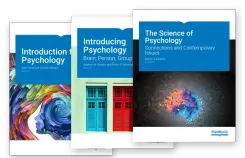
- Introduction to Psychology v5.0, Frantz and Stangor, published January 2026, 584 pages
- Introducing Psychology: Brain, Person, Group v6.0, Kosslyn and Rosenberg, published September 2025, 848 pages
- The Science of Psychology: Connections and Contemporary Issues v2.0, Shapiro, published September 2026, 776 pages
King’s The Science of Psychology and two more McGraw Hill titles, on Connect
Connect is $127.27 on all three McGraw Hill intro psychology titles we priced, and all three state “180 Days Access (Standard).” The e-book alone is $65.99 for 180 days, and McGraw Hill also rents King’s The Science of Psychology: An Appreciative View as a four-year e-book at $99.99. Print rents for 150 days at $78.00 or sells loose-leaf at $169.99, and McGraw Hill states that print “does not come with digital platform access.”
- The Science of Psychology: An Appreciative View, King, 2026 Release
- Experience Psychology, King, 2025 Release
- Understanding Psychology, Feldman, 2024 Release
Myers, DeWall and Gruber’s Psychology and eight more Macmillan titles, on Achieve
Macmillan sells Achieve for one term at $44.99 to $114.99, depending on the title, on the nine intro psychology titles we priced:
- Psychology 14e, Myers, DeWall and Gruber: Achieve $114.99, six-month e-book $80.99
- Psychology in Modules 13e, Myers and DeWall: Achieve $114.99, six-month e-book $80.99
- Psychology 7e, Schacter, Gilbert, Nock and Santos: Achieve $114.99, six-month e-book $80.99
- Discovering Psychology 10e, Nolan and Hockenbury: Achieve $99.99, six-month e-book $71.99
- Scientific American: Psychology 4e, Licht, Hull and Ballantyne: Achieve $99.99, six-month e-book $71.99
- Introducing Psychology 6e, Schacter, Gilbert, Wegner and Nock, copyright 2024: Achieve $99.99, six-month e-book $71.99
- Exploring Psychology 13e, Myers, DeWall and Gruber, copyright 2025: Achieve $99.99, six-month e-book $71.99
- Psychology in Everyday Life 7e, Myers, DeWall and Gruber, copyright 2026: Achieve $59.99, six-month e-book $44.99
- Psychology: A Concise Introduction 6e, Griggs and Jackson, copyright 2020: Achieve $44.99, six-month e-book $33.99
Macmillan also sells Read & Practice on eight of its nine intro psychology titles we priced, for one term, at $59.99 on seven and $49.99 on Psychology in Everyday Life. Macmillan calls Read & Practice “the marriage of our LearningCurve adaptive quizzing and our mobile, accessible e-book,” and instructors assign its sections and see the work in the gradebook. Macmillan’s purchase panels also state that Read & Practice carries no instructor resources or assignable assessments, so this comparison counts Read & Practice as an e-book tier rather than as homework included.
Macmillan sells its e-books for six months, and Schacter and colleagues’ Psychology 7e also for one year, at $100.99. On all nine titles, Macmillan also sells the e-books outright, from $50.99 for Psychology: A Concise Introduction to $120.99 on three titles, Myers, DeWall and Gruber’s 14e among them.
Ciccarelli and White’s Psychology and four more Pearson titles, Revel on four of the five
Revel is $96.99 on four of the five Pearson intro psychology titles we priced, each listed with “Up to 12-month access.” Wade, Tavris, Sommers and Shin’s Invitation to Psychology 8e lists no Revel option on its page. Pearson’s six-month eTextbook is $10.83 per month on all five. A lifetime eTextbook starts at $94.98, and a print rental is $89.99.
- Psychology 7e, Ciccarelli and White, published January 29, 2025, copyright 2026
- Invitation to Psychology 8e, Wade, Tavris, Sommers and Shin, published December 6, 2021, copyright 2022: no Revel option listed
- Psychology 2e, Hudson and Whisenhunt, published December 22, 2025, copyright 2026
- Psychology: An Exploration 5e, Ciccarelli and White, published December 21, 2021, copyright 2022
- Psychology: From Inquiry to Understanding 5e, Lilienfeld, Lynn and Namy, published April 1, 2022, copyright 2023
Grison, Chew and Glover’s Psychology in Your Life and one more Norton title, with InQuizitive
Norton sells two intro psychology bundles, each with the e-book, InQuizitive, ZAPS, the 3D Brain and videos:
- Psychology in Your Life 5e, Grison, Chew and Glover: $78.95, 180-day access
- Psychological Science 7e, Phelps, Berkman and Gazzaniga: $77.95, 360-day access
Norton also sells InQuizitive on its own at $42.00 and ZAPS at $25.00, and lists no e-book-only option. Norton lists an eighth edition of Psychological Science for fall 2027 courses.
Weiten and Gurung’s Psychology: Themes and Variations and six more Cengage titles, on MindTap or Cengage Infuse
Cengage sells MindTap at $83.00 to $127.00, depending on the title, for one term on six of the seven intro psychology titles we priced, and Cengage Infuse at $50.00 for one term on the seventh, Psychology: Modules for Active Learning. That title page describes Infuse as a “digital learning platform that leverages your Learning Management System” with “auto graded content,” and Cengage’s Infuse help page states that students can access their eBook and study tools at any time. On all seven titles, the e-book alone is $71.99 for 180 days or $98.99 for 360 days. Cengage also sells Cengage Unlimited, a subscription that includes “All of Cengage’s Learning Platforms,” MindTap among them, and “Thousands of Cengage eBooks.” Cengage Unlimited costs $169.99 for four months or $244.99 for 12 months.
- Essentials of Psychology: Applying the Science of Psychology to Life 7e, Nevid, copyright 2027: MindTap $127.00
- Introduction to Psychology: Gateways to Mind and Behavior 17e, Coon, Martini and Mitterer, copyright 2027: MindTap $127.00
- Psychology: Themes and Variations 12e, Weiten and Gurung, copyright 2027: MindTap $127.00
- What is Psychology? 6e, Pastorino and Doyle-Portillo, copyright 2027: MindTap $127.00
- Discovering Psychology: The Science of Mind 5e, Cacioppo, Freberg and Cacioppo, copyright 2027: MindTap $127.00
- Psychology: Modules for Active Learning 15e, Coon, Mitterer and Martini, copyright 2022: Cengage Infuse $50.00
- PSYCH 8e, Rathus and Rathus, copyright 2027: MindTap $83.00
Clayton, Privitera and Kassin’s Essentials of Psychology, on Sage Vantage
Sage prices Vantage at $98.00 for 180 days on Clayton, Privitera and Kassin’s Essentials of Psychology, 2nd edition, published September 2025. Sage’s e-book is $90.00, marked down to $85.50, for the same 180 days, and a lifetime e-book is $130.00. The paperback is $235.00.
Top Hat’s Introduction to Psychology, as an Interactive eText
Top Hat lists its Introduction to Psychology 2E, by Meaghan Altman and colleagues, at $89.00 as a “Top Hat Interactive eText (Read, Study + Assessment),” which requires a join code from the instructor. Top Hat says the title is “mapped to APA and IPI Learning Outcomes.” Top Hat’s pricing page lists platform access at $35 for four months, $58 for 12 months and $96 for four years. When an instructor assigns a Top Hat textbook, the pricing page states, a student’s “access price will be adjusted to include the price of the text.” The title page states no term for the $89.00.
Sanderson and Huffman’s Psychological Science: The Curious Mind and two more Wiley titles, on WileyPLUS or Top Hat
Top Hat sells each of the three Wiley titles below for $95.00, as a “Top Hat Interactive eText (Read, Study + Assessment)” that requires a join code from the instructor. Wiley’s own WileyPLUS courseware is $82.95 for a single term on Psychological Science: The Curious Mind. Wiley says the courseware blends text with videos, animations, interactive learning objects and online assessment, including adaptive assignments. Wiley’s support site states that a single-term WileyPLUS license lasts five months, and the three Top Hat title pages state no access length. At wiley.com, the Psychology in Action e-book is $57.00 to rent for 150 days or $128.95 to buy.
- Psychology in Action: Fundamentals of Psychological Science 13e, Huffman, Sanderson and Dowdell, published April 2025: Top Hat $95.00
- Psychological Science: The Curious Mind 1e, Sanderson and Huffman: WileyPLUS $82.95, Top Hat $95.00
- Real World Psychology 4e, Sanderson and Huffman: Top Hat $95.00
Hawkes Learning’s Introduction to Psychology, as Software + eBook
Hawkes Learning sells its Introduction to Psychology, 2nd edition, as Software + eBook, as a print textbook, or as both. Fourteen of the textbook’s 16 chapter titles match chapter titles in OpenStax’s free Psychology 2e word for word, in the same order. Hawkes says its online learning software “provides step-by-step learning, an unlimited number of practice questions, intelligent feedback for incorrect answers, and assessments to test students’ knowledge.” The Hawkes store lists the textbook at $62.40 and the textbook with Software + eBook at $114.39, and shows no price for Software + eBook.
Print prices across the publishers
Print prices vary more widely across the publishers than digital prices. Across the seven Cengage titles, print runs from $124.00 for PSYCH to $257.95. Macmillan’s paperbacks, on all nine titles, run from $62.99 for Psychology: A Concise Introduction to $339.99 for Myers, DeWall and Gruber’s 14e and two other titles. Pearson rents its print editions for $89.99, and Hawkes Learning’s print textbook is $62.40.
What a print edition includes differs by publisher. McGraw Hill rents its print edition for 150 days at $78.00 or sells it loose-leaf at $169.99, and neither includes Connect. Norton’s print editions come with the courseware, from $156.63 for Psychology in Your Life to $203.48 for the Psychological Science hardcover. Wiley’s Psychology in Action paperback, at $181.95, comes with an e-book access code, and Hawkes Learning sells its textbook with Software + eBook for $114.39. FlatWorld’s color print textbook is $64.95 with Basic Access included, or $84.95 with Standard, on all three intro psychology titles.
How Long Does Access to Each Psychology Textbook Last?
When online homework is included, access to a digital intro psychology textbook runs from four months to one year across the publishers that state a term. Every FlatWorld package runs one year, and the competitors’ homework-included options that state a term run four to 12 months. FlatWorld’s Terms of Use set the year as “a period of twelve months from the date of access.”
Norton, Cengage and Pearson each sell one option that includes homework and has a term near a year: Norton's Psychological Science bundle at 360 days, Cengage Unlimited at 12 months, and Pearson's Revel at up to 12 months. Top Hat sells platform access for 12 months ($58) or four years ($96) and adds an assigned textbook's price, but its title page states no term for the $89.00. The other competitor tiers that run past a year, Pearson's and Sage's lifetime e-books, McGraw Hill's four-year rental and Macmillan's e-books sold outright, come without the homework platform. The table below lists each digital tier of about one year or longer that we found, whether or not it includes homework:
Full detail and sourcing for every row appears in the article text and the Sources section below.
Cengage charges $27 more for the second six months of Nevid’s e-book.
Which to choose: A 180-day platform is a strong fit if your students finish the course within one term and do not need the material afterward; FlatWorld is the stronger fit if students may retake the course or need the material into the next semester, since every package runs one year.
Which Introductory Psychology Textbooks Include Online Homework in the Price?
Every commercial publisher we compared sells an intro psychology version with the textbook and assignable homework in one price. Eight of the nine competitors sell that version as a platform: Cengage’s MindTap and Cengage Infuse, Macmillan’s Achieve, McGraw Hill’s Connect, Pearson’s Revel, Sage’s Vantage, Wiley’s WileyPLUS, Hawkes Learning’s software and Top Hat. Norton, like FlatWorld, sells the textbook and homework as a bundled package. Hawkes Learning’s store shows no price for its software and e-book, so Hawkes is not in the list below.
In this comparison, “homework included” means the textbook content plus assignable, gradable homework in one price. Every price in this section is for digital access. The lower-priced competitor tiers that fail that definition are left out: Macmillan’s Read & Practice, from $49.99, which Macmillan says “does not include instructor resources and assignable assessments,” and Norton’s InQuizitive at $42.00 and ZAPS at $25.00, each sold without the e-book. E-book-only tiers fail the definition as well, such as Pearson’s six-month eTextbook at $10.83 per month, which lists study features but no assignable homework.
For commercially published titles, twelve per-title options include homework in the price:
- FlatWorld, $37.95 for Basic Access ($57.95 for Standard), one year, on all three intro psychology titles
- Macmillan Achieve, $44.99 to $114.99, one term, by title; $44.99 on Griggs and Jackson’s Psychology: A Concise Introduction
- Cengage Infuse, $50.00, one term, on Psychology: Modules for Active Learning 15e
- Norton, $77.95 for Psychological Science, 360 days
- Norton, $78.95 for Psychology in Your Life, 180 days
- WileyPLUS, $82.95 for Psychological Science: The Curious Mind, single term, which Wiley’s support site states is five months
- Cengage MindTap, $83.00 to $127.00, one term, by title; $83.00 on PSYCH 8e
- Top Hat, $89.00 for Introduction to Psychology 2E, term not stated on the title page
- Top Hat, $95.00 for each of three Wiley titles, term not stated on the title pages
- Pearson Revel, $96.99, up to 12 months
- Sage Vantage, $98.00, 180 days
- McGraw Hill Connect, $127.27, 180 days
Of the 33 commercially published titles with a posted homework price, FlatWorld’s three intro psychology titles cost the least, at $37.95 for Basic Access. The nearest competitor price is Macmillan’s Achieve for Griggs and Jackson’s Psychology: A Concise Introduction, copyright 2020, at $44.99: 19 percent more than FlatWorld Basic, for one term against FlatWorld’s year. FlatWorld Standard, at $57.95, is $12.96 more than that Achieve price, more than Cengage Infuse at $50.00 and less than every other commercially published title’s homework price.
Three options built on open textbooks, rather than commercially published titles, cost less than FlatWorld Basic. OpenStax’s textbook is free, and its Assignable courseware, with auto-graded assignments, starts at $15 per student, per course, per semester. Top Hat sells an interactive OpenStax edition inside its platform for $35.00, a price Top Hat says covers the platform alone. Lumen Learning’s Lumen One courseware, built around Lumen’s own open textbook and listing online homework, costs $35 per student per term, the price Lumen charges for any of its courses.
Each priced competitor platform includes the textbook, according to its publisher’s own pages, so each platform price covers the textbook and the homework. Macmillan lists an e-book as the first feature row for Achieve, and Cengage says that with MindTap, students “get full access to their eBooks,” and that Infuse students can access their eBook at any time. Pearson describes Revel as “an interactive, digital, and mobile learning environment that replaces the traditional printed text.” McGraw Hill lists “eBook access (with included ReadAnywhere app)” among Connect’s features, and Sage says Vantage “integrates quality Sage textbook content with assignable multimedia activities and auto-graded assessments.” Top Hat sells its own title and three of Wiley’s as a “Top Hat Interactive eText (Read, Study + Assessment),” and Wiley’s accessibility page states that WileyPLUS “features EPUB3-based eBooks.”
Norton’s lower-priced bundle is $77.95, against $37.95 for FlatWorld Basic Access, and FlatWorld Standard Access, at $57.95, is $20 less than that bundle.
Which to choose: Norton is a strong fit if you want InQuizitive, ZAPS and the 3D Brain bundled and a 180-day or 360-day term covers your course; FlatWorld is the stronger fit if you want every student on one homework platform for a year at $37.95 for Basic or $57.95 for Standard.
What Do You Give Up With a Cheaper Psychology E-Book Without Homework?
An intro psychology e-book sold without the homework platform leaves the homework to the instructor. The six-month or 180-day e-book costs a student less than Achieve, Connect, MindTap or Vantage on every title page that lists both prices, though not less than Cengage Infuse at $50.00. The saving runs from $8.00 at Sage, at list price, to $61.28 at McGraw Hill. Pearson’s six-month eTextbook is $10.83 a month. Wiley rents the Psychology in Action e-book for 150 days at $57.00, while Norton, Top Hat and Hawkes Learning list no e-book-only option on their title pages.
With an e-book alone, the instructor writes the questions or draws them from the publisher’s test bank, builds each assignment in the LMS, and grades whatever the LMS cannot score. FlatWorld Homework comes with questions written for each FlatWorld textbook and grades the answers. FlatWorld’s homework page states that instructors reported saving between 40 and 80 hours per semester or term by using FlatWorld Homework.
When a course assigns platform homework and the publisher also sells the e-book alone, a student who buys the e-book alone has no access to the assigned homework. The platform’s gradebook then covers only the students who paid for platform access.
FlatWorld sells no e-book-only package, so its lowest price, $37.95 for Basic Access, includes FlatWorld Homework for a year on all three titles. A student who buys any FlatWorld package can open the assigned homework at purchase, so the gradebook covers every student who bought the textbook. At $37.95, homework included, Basic Access costs less than the 180-day e-book alone at McGraw Hill ($65.99), Cengage ($71.99 for Nevid’s Essentials of Psychology) and Sage ($90.00, $85.50 on sale). Basic Access also costs less than Wiley’s 150-day Psychology in Action e-book rental, $57.00, and less than eight of the nine Macmillan six-month e-books we priced. The ninth, Griggs and Jackson’s Psychology: A Concise Introduction, is $33.99.
Which to choose: An e-book alone is a strong fit if you already run graded quizzes in your LMS and want a lower student price than the publisher's platform; FlatWorld is the stronger fit if you want the homework written for the textbook, graded for you and included in every package.
What Free Introduction to Psychology Textbooks Are Available?
OpenStax Psychology 2e and Noba are the two free introductory psychology options we compared. Neither free textbook includes graded homework, and OpenStax states that it is “working hard to achieve our goal of Level AA accessibility.”
OpenStax Psychology 2e is free to download as a PDF, carries a Creative Commons Attribution-NonCommercial-ShareAlike 4.0 license, and was published April 22, 2020, with its web version last updated July 9, 2026. OpenStax, the publisher, is part of Rice University. OpenStax also lists a test bank, an instructor answer guide and lecture slides for the title, free to instructors who sign up for an account.
Noba publishes 105 psychology modules by its own count under a Creative Commons Attribution-NonCommercial-ShareAlike 4.0 license. The Noba Collection textbooks are “expertly compiled from Noba modules to fit the scope and sequence of common courses.” Instructors can “use them as-is or customize them to fit your needs,” and Noba lists an instructor manual, PowerPoint presentations and a test bank “for many modules.”
OpenStax sells its homework system, Assignable, separately from the free textbook. OpenStax lists Assignable for Psychology 2e, and Assignable lets instructors “assign customized assessments, readings, and activities directly within your LMS,” with “auto-grading, instant feedback, and LMS grade sync.” Assignable costs from $15 per student, per course, per semester.
Top Hat sells an interactive edition of OpenStax Psychology 2e inside its platform. Interactive OpenStax: Psychology, 2e adds in-chapter questions and Top Hat’s revisions to the OpenStax text. Top Hat lists the edition at $35.00 as a “Top Hat Interactive eText (Read, Study + Assessment)” that requires a join code from the instructor. Top Hat says the price is for its platform, with “no additional cost for OpenStax,” and that students at its institution-wide partner schools pay nothing. The edition’s title page states no term, and Top Hat’s pricing page lists $35 for four months of platform access.
Lumen Learning publishes its Introduction to Psychology as open educational resources under a Creative Commons Attribution 4.0 license. Students reach it through Lumen One courseware, and Lumen charges $35 per student per term for any Lumen course, paid at the campus bookstore, by card inside the courseware or through an invoice to the institution. Lumen’s page states, “Online homework, self-check activities, and other interactive tools strengthen learning,” lists quiz banks and slide decks for instructors, and offers “automatic grade return” to Blackboard, Canvas, D2L and Moodle.
Noba’s quizzes are for self-study, and Noba’s pages describe no assignable, auto-graded homework system. In 2015 Noba added 20-item quizzes to a list of its modules, and students “can return to them as often as they like for review.” Without a paid homework product, an instructor builds graded homework in the LMS or grades by hand.
Accessibility is OpenStax’s second trade-off, after homework. Its accessibility statement commits to WCAG 2.1 Level AA and names “some areas that still need improving,” including parsing, error identification, focus order, use of color and sensory characteristics. Its help center calls the online web view “the most accessible format” and states that downloadable formats such as the PDF, along with some instructor and ancillary resources, “may have a different accessibility status.” The ADA Title II rule in the accessibility section sets WCAG 2.1 Level AA for a public college’s digital course content.
Our comparison of OER and FlatWorld covers what free OER costs in homework, instructor time and support, how its quality varies from source to source, and where it stands on the federal accessibility deadline. Our comparison of Lumen Learning and FlatWorld covers Lumen’s courseware and its fee.
Which to choose: OpenStax is a strong fit if you want a free textbook and will add homework through Assignable, Top Hat's interactive edition or your LMS, and check its accessibility status for your course; FlatWorld is the stronger fit if you want the homework system, a local rep and a platform that states it meets WCAG 2.2 Level AA, all included in the textbook price.
Which FlatWorld Introductory Psychology Textbook Fits Your Course?
FlatWorld’s Frantz and Stangor textbook fits a general-audience course, Kosslyn and Rosenberg’s a course taught at three levels of analysis, and Shapiro’s a course built around current issues. All three titles sell at the same prices in the same four packages.
Frantz and Stangor, Introduction to Psychology v5.0
Frantz and Stangor’s Introduction to Psychology v5.0 suits most introductory psychology sections, with an applied approach to the field. FlatWorld’s catalog page describes a “What Does My Neighbor Need to Know About Psychology” organizing structure that “focuses learners on the most significant and memorable aspects of psychology.” The catalog describes the textbook as “appealing to both majors and non-majors alike.” APA’s seven integrative themes are “woven throughout the text” of its 584 pages.
Kosslyn and Rosenberg, Introducing Psychology: Brain, Person, Group v6.0
Kosslyn and Rosenberg’s Introducing Psychology: Brain, Person, Group v6.0 suits a course that treats biological, individual and social explanations together. The catalog page describes an 848-page textbook with a “Mainstream approach built around three levels of analysis (brain, person, group),” and “Over 65 embedded hyperlinks to streaming videos.”
Shapiro, The Science of Psychology: Connections and Contemporary Issues v2.0
Shapiro’s The Science of Psychology: Connections and Contemporary Issues v2.0 suits a course that treats psychology as a natural science and ties it to current issues and to evaluating claims. The catalog page states that the textbook “helps students explore the science of the mind interwoven with the topics of psychology that matter today.” Every chapter ends with a Contemporary Issues section, and a “Myths, Lies, and Scams” feature appears 27 times. The textbook runs 776 pages, with “over 290 embedded links to curated videos and webpages.”
How Do You Justify an Intro to Psychology Textbook Change to Your Department?
An instructor can justify a textbook change to the department with three facts from each publisher's own page: the student price, what that price includes, and what the instructor gets with the adoption. The table below totals what a section pays at three sizes, at FlatWorld's two digital packages and at the current editions of the five widely adopted titles from the 2025 Teaching of Psychology study, each with online homework included. Basic Access is the like-for-like comparison, because it includes what each platform in the table sells: the textbook and online homework. Standard Access adds a copy-protected PDF, the audiobook and chapter podcasts:
Full detail and sourcing for every row appears in the article text and the Sources section below.
Students in a 150-seat section, who each buy their own access, pay $6,150 to $13,398 less in total at FlatWorld Basic Access than on the platforms for the five widely adopted titles. At Standard Access, the same section pays $3,150 to $10,398 less. Against Macmillan’s Achieve for Psychology: A Concise Introduction, the nearest price among commercially published titles, the section pays $1,056 less at Basic Access.
Use the savings calculator to see what a section your size would pay.
FlatWorld’s instructor materials and custom editions come with the adoption at no extra cost. The help center’s LMS guides walk through the setup, and the staffed support line handles the roster and gradebook problems of the first week.
“FlatWorld has been tremendously helpful with my course and managing large numbers of students. The attentive and kind service by my rep, and the help from the technical support team, are simply the best I’ve encountered in my many textbooks over many years of teaching! My Intro Psych FlatWorld text and supplements are exceptionally high quality and very multi-modal, yet the price is among the lowest I’ve seen for college textbooks. I cannot recommend them enough!”
Dr. Rick Tillman, Psychology faculty, University of Cincinnati
Frequently Asked Questions
How much does an introduction to psychology textbook cost?
A student pays $37.95 to $127.27 when online homework is included, on the 33 commercially published titles with a posted homework price. The two lowest are FlatWorld Basic Access, $37.95 for a year on all three titles (Standard is $57.95), and Macmillan's Achieve for Psychology: A Concise Introduction, $44.99 for one term. OpenStax's and Noba's textbooks are free.
Is homework included in the price of an intro psychology textbook?
Sometimes. Every FlatWorld package includes homework, at $37.95 for Basic Access or $57.95 for Standard, and each competitor includes homework only in its platform or bundle version. On the commercially published titles in this comparison, those versions run from $44.99 for Macmillan's Achieve on Psychology: A Concise Introduction to $127.27 for McGraw Hill Connect.
Is there a lower-cost alternative to Myers, DeWall and Gruber's Psychology?
Yes. With online homework included, Myers, DeWall and Gruber's Psychology 14e costs a student $114.99 for one term of Macmillan's Achieve, while each FlatWorld intro psychology title costs $37.95 for a year of Basic Access ($57.95 for Standard).
What does an instructor get with a FlatWorld intro psychology adoption?
Every instructor tool in a FlatWorld adoption comes at no extra cost. The three FlatWorld titles list an Instructor's Manual, PowerPoint slides, the FlatWorld Exam Builder, Test Bank Files and Test Item Files. FlatWorld Homework, SmartHelper and the Engagement Manager come with every adoption, FlatWorld's team builds custom editions, and the local rep stays the same across semesters.
What happens to a student's textbook if they retake the course?
With FlatWorld, a student who bought within the previous twelve months still has access, because the term runs a year from the date of access. On a 180-day platform, a student who retakes the course after access ends needs new access. Check the access term at the publisher's own page for any title you are considering.
Can a department mix FlatWorld's intro psychology titles across sections?
Yes. All three FlatWorld titles share the same prices and the same four packages, so a department can assign one title in some sections and another in the rest, and no student pays a different price. Instructor materials, LMS integration and customization come with every adoption.
Is a free textbook enough for a college Psych 101 course?
Partly. A free textbook covers the course content but not graded homework: OpenStax sells auto-graded homework through Assignable, from $15 per student, per course, per semester, and Noba's quizzes are self-study only. OpenStax also states that it is "working hard to achieve our goal of Level AA accessibility."
Does the APA recommend a particular intro psychology textbook?
No. None of the APA Introductory Psychology Initiative pages cited here names a textbook. The Initiative keeps APA's five content pillars on a research methods foundation and adds seven integrative themes. FlatWorld's Frantz and Stangor title includes APA's integrative themes, a choice about how the textbook is organized and not an endorsement by APA.
What should you compare when choosing an affordable intro psychology textbook?
Before adopting, compare whether the lowest-priced version a student can buy includes assignable homework, how long access lasts and what a longer term costs. Then check whether instructor materials exist for the edition you would adopt and whether the publisher posts its accessibility conformance report, sends the report on request or links no report.
Sources
Every price and access term in this list comes from the publisher’s own page, or from Top Hat’s for the Wiley titles it sells, as of the date shown. Prices change, so check the seller’s own page on the day you need the number.
FlatWorld
- FlatWorld, Introduction to Psychology v5.0 (Frantz and Stangor), Buy flow. Basic Access $37.95, with SmartHelper; Standard Access $57.95; Print + Basic Access $64.95; Print + Standard Access $84.95; each for one year. Read September 22 and September 28, 2026. Edition page: published January 2026, 584 pages, the organizing structure and APA themes as quoted, and the Supplements tab. Read September 28, 2026; Buy flow and edition page re-read October 20, 2026, when the Supplements tab listed AI Activities and Sample Syllabi among its eight items. FlatWorld home page: instructor supplements, the homework system and the customization platform come with the adoption “at no extra cost.” Read September 30, 2026.
- FlatWorld, Introducing Psychology: Brain, Person, Group v6.0 (Kosslyn and Rosenberg), Buy flow. Same four packages, prices and access term. Read September 22 and September 28, 2026. Edition page: published September 2025, 848 pages, over 65 embedded video links, and the Supplements tab. Read September 28, 2026; Buy flow and edition page re-read October 20, 2026, when the Supplements tab listed AI Activities and Sample Syllabi among its eight items.
- FlatWorld, The Science of Psychology: Connections and Contemporary Issues v2.0 (Shapiro), Buy flow. Same four packages, prices and access term. Read September 22 and September 28, 2026. Edition page: published September 2026, 776 pages, over 290 embedded links. Read September 28, 2026, when the page stated “Homework and supplements available October 15, 2026.” Buy flow and edition page re-read October 20, 2026: no date notice, and the Supplements tab lists FlatWorld Homework, AI Activities, an Instructor’s Manual, PowerPoint Lecture Notes, a Test Generator, Test Bank Files and Test Item Files.
- FlatWorld Terms of Use. Online e-book access “for a period of twelve months from the date of access.” Read September 21 and September 30, 2026.
- FlatWorld Accessibility. “FlatWorld meets the WCAG 2.2 Level AA standards”; integration “with Canvas, Blackboard, Moodle, and Brightspace”; the 2018 “digital-first” redesign and launch of the Homework system; the 2018 Perkins School for the Blind collaboration; and the 2019 catalog-wide audit. Read September 28, October 20 and October 27, 2026.
- FlatWorld VPAT, “Updated July 2026,” linked from source 5 on September 28, 2026.
- FlatWorld Help Center, Learning Management Systems collection for instructors and admins. LTI 1.3 configuration guides for Blackboard, Canvas, Brightspace and Moodle; Sakai setup under LTI 1.1; test bank import guides; guides to syncing and resending grades in Canvas and Blackboard. Read September 28, 2026.
- FlatWorld Customer Support Hours and Contact Information. Staffed hours as listed. Read September 28 and October 20, 2026.
- FlatWorld SmartHelper: “AI study help that answers only from the material you assign”; “Included with both the Basic and Standard packages”; “numbered citations that link to the exact passages behind the answer.” Read October 5, 2026.
- FlatWorld Homework: homework “included with every textbook”; “FlatWorld authors are involved in ensuring that the questions specifically match the pedagogy of the textbook”; manage FlatWorld Homework “through your institution’s Learning Management System or use the interface as a stand-alone system”; “compatible with Blackboard, Canvas, Moodle, and Brightspace D2L”; “Questions in Multiple Formats, Written for Your Book”; “Simply log in and assign, FlatWorld will do the grading for you”; “Instructors also shared that they saved between 40 and 80 hours per semester or term because of their use of the FlatWorld Homework system.” Read October 5, 2026.
- FlatWorld, the Engagement Manager: a dashboard that tracks student engagement with the textbook, included with every adoption at no extra cost. Confirmed by FlatWorld on October 5, 2026. FlatWorld’s help center describes the same dashboard as Course Engagement, in “Using Course Engagement from your Bookshelf (Instructor),” which lists “Latest Access,” “Days Accessed,” “Section Count,” “Videos Viewed,” “Search Count,” “Flashcard Tests,” “Quiz Question Attempts” and “Annotation Count.” Read October 20, 2026, when FlatWorld confirmed that Course Engagement is the Engagement Manager.
Cengage
- Cengage title pages, with MindTap’s price for one term: Nevid, Essentials of Psychology: Applying the Science of Psychology to Life 7e, copyright 2027, $127.00; Coon, Martini and Mitterer, Introduction to Psychology: Gateways to Mind and Behavior 17e, copyright 2027, $127.00; Weiten and Gurung, Psychology: Themes and Variations 12e, copyright 2027, $127.00; Pastorino and Doyle-Portillo, What is Psychology? 6e, copyright 2027, $127.00; Cacioppo, Freberg and Cacioppo, Discovering Psychology: The Science of Mind 5e, copyright 2027, $127.00; Rathus and Rathus, PSYCH 8e, copyright 2027, $83.00. Each MindTap is sold as “1 term Instant Access,” and every page but Cacioppo, Freberg and Cacioppo’s states that with MindTap, students “get full access to their eBooks.” Read October 20, 2026.
- Cengage, e-book tiers on the seven titles in sources 12 and 15: $71.99 with access until April 18, 2027, and $98.99 until October 15, 2027, which is 180 and 360 days from the read date. Read October 20, 2026. Earlier reads: Nevid’s 6e, ISBN 9780357375617, with MindTap at $127.00 for “1 term (4 months)” and the same two e-book prices, September 21, 2026; Weiten and Gurung’s 12e, October 6, 2026.
- Cengage Unlimited: includes “All of Cengage’s Learning Platforms (MindTap, WebAssign, SAM, CNOWv2 and OWLv2)” and “Thousands of Cengage eBooks”; “subscription durations of 1 term (4 months) or 2 terms (12 months)”; $169.99 for one term on that page, and $169.99 or $244.99 on each title page in source 12. Read September 21, September 28 and October 20, 2026.
- Cengage print prices across the seven titles: $124.00 (PSYCH 8e); $230.95 (Weiten and Gurung; Pastorino and Doyle-Portillo; Coon, Mitterer and Martini, Psychology: Modules for Active Learning 15e, copyright 2022; $257.95 (Nevid; Coon, Martini and Mitterer’s Gateways; Cacioppo, Freberg and Cacioppo). The Modules page lists no MindTap purchase option. It sells Cengage Infuse, “1 term Instant Access,” at $50.00, and describes Infuse as a “digital learning platform that leverages your Learning Management System” with “auto graded content.” Cengage’s Infuse student help page, states: “Access your eBook and study tools any time through your Cengage account.” Read October 20, 2026.
- Cengage Instructor Center, Nevid, Essentials of Psychology: Applying the Science of Psychology to Life 7e, the edition in source 12, Resources tab: “Teaching Resources” (Image Only PowerPoint, Instructor Manual, PowerPoint), “Assessment Resources” (Test Banks, as Angel, Blackboard, Canvas, D2L and Moodle files) and “Additional Resources” (Mastery Training, MindTap Educator Guide, Transition Guides), each marked “sign in to download.” Read October 20, 2026. Earlier read: the 6e’s Instructor Center, September 28, 2026.
- Cengage, MindTap LMS integration: Canvas, Schoology, Brightspace by D2L, Blackboard and Moodle, plus “Other LMS Integration Services for LTI Compliant Systems.” Read September 28, 2026.
- Cengage Accessibility and VPAT: “We’re taking active steps to make sure our products adhere to WCAG 2.2 AA”; “Our current VPATs will still show gaps to compliance, so we can share updated VPATs when our remediation work is complete”; updated roadmaps “available by request”; MindTap VPATs listed for download, including “MindTap - Latest Updates” (July 2026). Read September 28, 2026.
- Cengage, custom-solutions pages for CengageCompose and custom digital solutions: “Enrollment Minimum: 20” for CengageCompose books; “Enrollment Minimum: 400 Annually” for custom digital products; “contact your local Custom Editor.” The pages are undated and name retired learning management systems, so their terms may not be current. Read September 30, 2026.
Macmillan Learning
- Macmillan Learning purchase panels for Myers, DeWall and Gruber, Psychology 14e; Myers and DeWall, Psychology in Modules 13e; Schacter, Gilbert, Nock and Santos, Psychology 7e. Achieve $114.99 for one term, e-book $80.99 for six months and $120.99 to buy, on all three. Read September 21 and October 20, 2026; on October 20 the 14e page listed its authors as “David G. Myers; C. Nathan DeWall; June Gruber.” The 14e e-book to buy was first read September 16, 2026. On October 20, Schacter and colleagues’ 7e also listed a one-year e-book, “Access ( 1 year ),” at $100.99.
- Macmillan Learning purchase panels for Nolan and Hockenbury, Discovering Psychology 10e, and Licht, Hull and Ballantyne, Scientific American: Psychology 4e. Achieve $99.99, six-month e-book $71.99, e-book $107.99 to buy. Read September 21 and October 20, 2026.
- Macmillan Learning, Read & Practice $59.99 on the five Macmillan titles read September 21, 2026. Read & Practice page: “the marriage of our LearningCurve adaptive quizzing and our mobile, accessible e-book”; instructors assign sections and “can see all this work in the gradebook.” Read September 28, 2026.
- Macmillan Learning, Myers, DeWall and Gruber, Psychology 14e, paperback $339.99, on the purchase panel in source 20. Read September 21 and October 20, 2026.
- Macmillan Learning, Achieve product comparison page, listing an e-book as the first feature row for Achieve, Read & Practice and Essentials. Read September 21 and October 20, 2026.
- Macmillan Learning, Myers, DeWall and Gruber, Psychology 14e product page, Instructor Resources: “You need to sign in as a verified instructor to access the Test Bank”; downloadable resources including an IRM (instructor’s resource manual), Image Slides, Clicker Questions and an intro psychology video collection. Read September 28, 2026.
- Macmillan Learning, LMS Integration: “We currently work with Blackboard Learn, Brightspace, Canvas, Moodle and Joule by Moodlerooms”; basic integration “allows for single sign-on and single-column gradebook sync,” and deep integration adds automatic grade sync. Read September 28, 2026.
- Macmillan Learning, Accessibility, with its Overview, Make a Request, Resources, Title II, Initiatives and Vendor Requirements pages. Standards “align with Section 508 requirements… and WCAG 2.2 AA guidelines”; the Title II page: “Macmillan Learning is working towards a platform that meets all requirements for WCAG 2.1 AA,” and the “first publisher with Benetech-Certified Accessible eBooks”; the Initiatives page: “updating legacy content and embedding WCAG 2.2 AA standards into all future products.” No conformance report is linked from any of the seven pages. Read September 28, 2026.
- Macmillan Learning purchase panels for Schacter, Gilbert, Wegner and Nock, Introducing Psychology 6e, copyright 2024; Myers, DeWall and Gruber, Exploring Psychology 13e, copyright 2025; Myers, DeWall and Gruber, Psychology in Everyday Life 7e, copyright 2026; and Griggs and Jackson, Psychology: A Concise Introduction 6e, copyright 2020. Achieve $99.99, $99.99, $59.99 and $44.99, one term; Read & Practice $59.99, $59.99 and $49.99, none listed for Griggs and Jackson; six-month e-book $71.99, $71.99, $44.99 and $33.99, or bought outright at $107.99, $107.99, $66.99 and $50.99; paperback $269.99, $269.99, $189.99 and $62.99. Read September 30 and October 20, 2026.
- Macmillan Learning, the same four purchase panels, frequently asked questions: “Achieve Read & Practice only includes our e-book and adaptive quizzing, and does not include instructor resources and assignable assessments. Read & Practice does integrate with LMS.” Read September 30, 2026.
- Macmillan Learning, Custom Solutions: “Reorder chapters, add original work, embed campus resources”; entry point “Contact a Specialist.” Read September 29, 2026.
McGraw Hill
- McGraw Hill title pages for King, The Science of Psychology: An Appreciative View (2026 Release), and King, Experience Psychology (2025 Release), at the URLs in source 33, and Feldman, Understanding Psychology (2024 Release). Connect “180 Days Access (Standard) - $127.27” on all three. Read September 21 and October 20, 2026.
- McGraw Hill e-book and print tiers on King’s The Science of Psychology: eBook Rental “180 Days Access (Standard) - $65.99” and “Extended Access (Alternate) - $99.99,” which shows an expiry date four years out when selected; print, a “Textbook Rental” with “150 Days Access” at $78.00 or a “Loose-Leaf Purchase” at $169.99, on all three McGraw Hill titles, with the note that print “does not come with digital platform access.” Read September 21 and October 20, 2026.
- McGraw Hill, Connect tab on King, Experience Psychology and King, The Science of Psychology: An Appreciative View: “180 Days Access (Standard) - $127.27.” Connect Details on Experience Psychology: “Integrates in your LMS. Prebuilt courses, presentation slides and instructor resources. Test question banks, adaptive assignments, essay prompts, video content and more interactive exercises specific to your course subject. eBook access (with included ReadAnywhere app).” Read September 28, 2026.
- McGraw Hill, Learning Management System Integration: Blackboard Learn, D2L Brightspace, Canvas and Moodle; LTI Advantage, “which includes single sign-on (SSO), assignment-level linking, and gradebook sync.” Read September 28, 2026.
- McGraw Hill, Accessibility: “McGraw Hill makes every effort to ensure our content and technology follows the Web Content Accessibility Guidelines (WCAG 2.2 Level AA)”; “Request a copy of an Accessibility Conformance Report (ACR).” Read September 28, 2026.
Pearson
- Pearson title pages for Ciccarelli and White, Psychology 7e (published January 29, 2025, copyright 2026); Wade, Tavris, Sommers and Shin, Invitation to Psychology 8e; Hudson and Whisenhunt, Psychology 2e (published December 22, 2025, copyright 2026). Revel $96.99 on all three. Read September 21, 2026. Revel’s “Up to 12-month access” and the prices re-read on all three September 28, 2026: Ciccarelli and White, Wade and colleagues, and Hudson and Whisenhunt. On October 20, 2026, the Invitation to Psychology page listed no Revel option, and the other four pages in sources 36 and 41 still listed Revel at $96.99 with “Up to 12-month access.”
- Pearson eTextbook and print tiers on the same titles: six-month eTextbook $10.83 per month; lifetime eTextbook from $94.98; print “Rental + Paperback,” $89.99, “A print edition you can rent,” with an “Option to keep after rental expires.” Read September 21, September 28 and October 20, 2026.
- Pearson, Hudson and Whisenhunt, Psychology 2e, Revel option (ISBN 9780135329627): “Up to 12-month access,” $96.99; registration “via course invite or LMS link” for Blackboard, Canvas, Moodle or D2L; Revel described as “An interactive, digital, and mobile learning environment that replaces the traditional printed text.” Read September 28, 2026.
- Pearson, educator view of the same title: “Sign in and browse downloadable instructor resource manuals and worksheets, Test Banks and more”; “Instructor’s Guides,” “Presentation Files,” “Test Item Files”; “Registration required.” Read September 28, 2026.
- Pearson, Accessibility: “we build our courseware, learning tools, supplemental materials, and digital textbooks to meet WCAG 2.2 AA”; accessibility documents “can be requested by emailing” Pearson’s disability support address; “Completed Voluntary Product Accessibility Templates (VPATs) are available for our learning platforms.” Read September 28, 2026.
- Pearson title pages for Ciccarelli and White, Psychology: An Exploration 5e (published December 21, 2021, copyright 2022), and Lilienfeld, Lynn and Namy, Psychology: From Inquiry to Understanding 5e (published April 1, 2022, copyright 2023). Revel $96.99, “Up to 12-month access”; six-month eTextbook $10.83 per month; lifetime eTextbook from $94.98; print rental $89.99. Read September 30 and October 20, 2026.
W. W. Norton
- Norton, Phelps, Berkman and Gazzaniga, Psychological Science, Seventh Edition. Ebook Courseware with InQuizitive, ZAPS, the 3D Brain and videos, $77.95, 360-day access; print with courseware $162.78 loose-leaf, $183.13 paperback, $203.48 hardcover; no e-book-only option listed. The Eighth Edition page, lists the new edition for fall 2027 courses. Read September 29 and October 20, 2026.
- Norton, Grison, Chew and Glover, Psychology in Your Life, Fifth Edition. Norton Illumine Ebook Courseware with InQuizitive, ZAPS, the 3D Brain and videos, $78.95, 180-day access; paperback with courseware $156.63; no e-book-only option listed. Read September 21, September 29 and October 20, 2026.
- Norton, standalone pricing on both title pages: InQuizitive, with the 3D Brain and videos, $42.00; ZAPS, with the 3D Brain and videos, $25.00. Read September 29 and October 20, 2026.
- Norton, Phelps, Berkman and Gazzaniga, Psychological Science, instructor resources: “Norton provides high-quality, book-specific resources for your teaching and assessment needs”; Norton Teaching Tools; Norton Testmaker, to “Search and filter test bank questions.” Read September 28, 2026.
- Norton, InQuizitive LMS integration: “LMS integration allows for automatic gradebook updates, single sign-on to InQuizitive activities, and automatic enrollment of students into correct Student Sets”; Blackboard, Canvas, D2L/Brightspace, Moodle, Sakai and Schoology. Read September 28, 2026.
- Norton, Accessibility and accessibility documentation: “W. W. Norton is proud to be a Benetech GCA certified publisher, producing ebooks that are born-accessible”; conformance reports to download for InQuizitive, the Norton Illumine Ebook, Smartwork, Tutorials and ZAPS Interactive Labs; “Each ACR also includes a roadmap of planned improvements.” No WCAG level is stated for Norton’s own products on the three pages read, the third being title II readiness and compliance. Read September 28, 2026.
Sage
- Sage, Clayton, Privitera and Kassin, Essentials of Psychology, 2nd edition, September 2025. Vantage Learning Platform $98.00 for 180 days, ISBN 9798348808532. Read September 21 and October 20, 2026.
- Sage, same title: e-book $90.00 marked down to $85.50 for 180 days, lifetime e-book $130.00 (ISBN 9781071930731), paperback $235.00 (ISBN 9781071930755). Read September 21 and October 20, 2026.
- Sage, same title: “This text is offered in Sage Vantage, an intuitive learning platform that integrates quality Sage textbook content with assignable multimedia activities and auto-graded assessments”; Instructor Resources: “Instructors, you can now access and download textbook resources directly from this page. Simply log in to your Sage account,” with an LMS cartridge including the test bank, PowerPoints, lecture notes and an instructor manual. Read September 28, 2026.
- Sage Vantage: “customizable LMS integration,” single sign-on, and “automatic grade sync and full gradebook integration options”; Linking Your Course: setup sessions for Blackboard, Canvas, D2L and Moodle. Read September 28, 2026.
- Sage, Accessibility statement: “Sage already tests against WCAG 2.2 AA, which incorporates WCAG 2.1 AA and adds additional criteria”; Sage “continually works toward full WCAG 2.2 AA compliance for its digital products and platforms” and notes that “legacy content may need remediation to be fully accessible”; “Platform VPATs are available on request.” The Sage Vantage Student Site Accessibility Guide, last updated March 15, 2024, routes VPAT requests to the same team by email. Read September 28, 2026.
Top Hat
- Top Hat, Introduction to Psychology 2E (Meaghan Altman, et al.): “Top Hat Interactive eText (Read, Study + Assessment),” which requires a join code from the instructor, $89.00, “all prices represent net price, not including 3rd party markups”; “mapped to APA and IPI Learning Outcomes”; the course contents list “Instructor Resources.” No access term is stated. Read September 30 and October 20, 2026.
- Top Hat Pricing: “$35 USD for 4-months of access; $58 USD for 12-months of access; $96 USD for 4-years of access”; “If your instructor is assigning a Top Hat interactive textbook as part of your course, your access price will be adjusted to include the price of the text.” Read September 30 and October 20, 2026.
- Top Hat Accessibility: “Built in line with WCAG 2.1 Level AA and Section 508 standards”; “A third-party vendor conducts regular audits across our student engagement platform to validate our accessibility compliance”; VPATs for the student and professor web apps (April 2026) and the mobile apps (January 2022). Read September 30, 2026.
- Top Hat Integrations: Canvas, Blackboard, D2L Brightspace, Moodle and Sakai; “Our new LTI 1.3 integration is 1EdTech-certified”; “deep linking, automatic grade syncing and automatic roster syncing.” Read September 30, 2026.
- Top Hat, Interactive OpenStax: Psychology, 2e (OpenStax, Top Hat): “Top Hat Interactive eText (Read, Study + Assessment),” “REQUIRES A JOIN CODE FROM INSTRUCTOR,” $35.00, “Price reflective of Top Hat platform; no additional cost for OpenStax”; no access term on the page. Top Hat’s OpenStax page: “Institution-wide partners get access to Top Hat with Interactive OpenStax at no cost to the student.” Read September 30 and October 20, 2026.
Free and open options
- OpenStax, Psychology 2e: PDF download; “Creative Commons Attribution-NonCommercial-ShareAlike License v4.0”; “OpenStax is part of Rice University”; “Publish Date: Apr 22, 2020” and “Web Version Last Updated: Jul 09, 2026” (read October 20, 2026); Assignable Courseware listed for the title, ISBN-13 978-1-961584-76-1, which lets instructors “assign customized assessments, readings, and activities directly within your LMS,” with “auto-grading, instant feedback, and LMS grade sync,” in an LMS “including Blackboard, Canvas, D2L Brightspace, Moodle, and Schoology.” Read September 28, 2026. Instructor resources tab: “Access free resources integrated with your book,” including a test bank, an instructor answer guide and lecture slides, for instructors who sign up for an account. OpenStax About page: “Every textbook in our library is free to read online or download as a PDF.” Both read September 30, 2026. Chapter list from the preface: 16 chapters, from “Introduction to Psychology” to “Therapy and Treatment.” Read October 20, 2026.
- OpenStax Assignable pricing: “Assignable is a paid offering from OpenStax, starting at $15 per student per course per semester.” Read July 6 and September 28, 2026.
- Noba: “Teach and learn psychology for free”; Creative Commons Attribution-NonCommercial-ShareAlike 4.0; Noba Collection textbooks “Expertly compiled from Noba modules to fit the scope and sequence of common courses” (“Use them as-is or customize them to fit your needs”); “Instructor manual, PowerPoint presentations, and test bank available for many modules”; 105 modules. Read September 28, 2026.
- Noba, self-study quizzes announcement, posted December 9, 2015: “20-item self-study quizzes for students,” which students “can return to them as often as they like for review.” Read September 28, 2026.
American Psychological Association
- APA, “Selecting Content for the Introductory Psychology Course” (Gurung and Neufeld). Names the five pillars and suggests instructors “cover at least two topics from each of five domains or pillars.” Read September 16, 2026.
- APA Introductory Psychology Initiative, the equity theme quoted verbatim from APA’s poster “Psychology’s Integrative Themes,”. Read September 28, 2026.
Accessibility law
- U.S. Department of Justice, ADA Title II rule on the accessibility of web content, WCAG 2.1 Level AA, interim final rule of April 20, 2026. Read July 6 and September 28, 2026.
Student cost survey
- Student PIRGs, “Fixing the Broken Textbooks Market, Fourth Edition,” February 10, 2026, and the report PDF. A survey of “more than 4,000 students at over 100 institutions” in September and October 2025 (107 campuses in 25 states, most respondents at public four-year universities). 66 percent “reported skipping the purchase of a textbook due to cost”; 70 percent skipped a textbook or access code at some point, “the highest percentage observed across the four editions of this report”; “81% of students who skipped purchasing a textbook or access code said they were concerned that doing so would negatively affect their grade”; 38 percent reported that the cost of textbooks or access codes affected their academic experience. Read October 5, 2026.
Studies of introductory psychology textbooks
- Rutter, L. P., Slade, J. J., and Gurung, R. A. R., “What’s Hot in Psychology Today? Introductory Psychology Textbooks Coverage of Material in High-Impact Factor Journals,” Teaching of Psychology, published online October 21, 2025: the study compares journal keywords “to key terms from five widely adopted introductory psychology textbooks,” listed in its references as Ciccarelli and White, Psychology 6e (Pearson); DeWall and Myers, Psychology 13e (Macmillan); Gazzaniga and Grison, Psychology in Your Life 3e (Norton); King, The Science of Psychology: An Appreciative View 5e (McGraw-Hill); and Weiten, Psychology: Themes and Variations 10e (Cengage). Read October 6, 2026.
Lumen Learning
- Lumen Learning, Introduction to Psychology course page: “Ready-to-adopt open educational resources (OER) include text, videos, simulations, self-checks, and other interactives”; “Online homework, self-check activities, and other interactive tools strengthen learning”; “Easy access to course materials in your LMS (Blackboard, Canvas, D2L, and Moodle) plus automatic grade return”; instructor resources “like quiz banks, assignments, slide decks, etc.”; content licensed under the Creative Commons Attribution 4.0 License. Read October 6, 2026.
- Lumen Learning, payment options: $35 per student per term for any Lumen course, standard implementation, paid through a campus bookstore activation code, by credit card inside the courseware, or by institutional invoice after the add/drop deadline. Read October 6, 2026.
Wiley
- Wiley, Psychology in Action: Fundamentals of Psychological Science, with eBook Access Code, 13th Edition (Huffman, Sanderson and Dowdell), ISBN 978-1-394-24148-4, April 2025, 704 pages: e-book rental, 150 days, $57.00; e-book $128.95; paperback $181.95. Read October 6 and October 20, 2026. Its Instructor Companion Site, linked from that page as “View Instructor Companion Site,” lists an “Instructor Manual,” “Lecture Power Points,” a “Test Bank,” a “TestGen Computerized Test Bank,” and “Application Questions,” “Review Questions” and “Matching Questions” for each chapter. Read October 20, 2026.
- Top Hat, three Wiley titles, each a “Top Hat Interactive eText (Read, Study + Assessment)” at $95.00 that requires a join code from the instructor, with no access term stated: Psychology in Action 13e; Psychological Science: The Curious Mind 1e; Real World Psychology 4e. Each page states that the eText combines the content of the Wiley title “with the dynamic engagement features of Top Hat.” Read October 6 and October 20, 2026.
- WileyPLUS, Psychological Science: The Curious Mind, 1st Edition (Sanderson and Huffman): “SINGLE-TERM $82.95 USD”; course “Introductory Psychology”; courseware that blends text, videos, animations, interactive learning objects and online assessment, including adaptive assignments. Read October 6 and October 20, 2026. Wiley’s support article “WileyPLUS: Registration Code Validity and Access Duration,” dated August 6, 2026: “Single-term access: 5 months” and “Multi-term access: 12 months.” Read October 20, 2026.
- WileyPLUS, LMS Integration: Blackboard, Canvas, Desire2Learn and Moodle, one login, registration from the LMS course, and “either total score or assignment-level grade integration to track all scores in one place.” WileyPLUS, Accessibility, “Updated: August 2021”: accessibility measured against “(WCAG) 2.1 AA and Section 508”; the VPAT and accessibility roadmap by email to accessibility@wiley.com; a partnership with TetraLogical “to evaluate and regularly audit our product’s accessibility”; “WileyPLUS features EPUB3-based eBooks.” Read October 6, 2026.
Hawkes Learning
- Hawkes Learning, Introduction to Psychology, 2nd Edition: Textbook (ISBN 978-1-64277-696-6), Software + eBook + Textbook (978-1-64277-694-2) and Software + eBook (978-1-64277-692-8), no prices listed; the online learning software “provides step-by-step learning, an unlimited number of practice questions, intelligent feedback for incorrect answers, and assessments to test students’ knowledge”; the test generator “provides a robust question bank and question authoring tool to create tests and quizzes that can be printed or administered securely online.” Read October 6, 2026. Re-read October 20, 2026: “Buy Digital” leads to account creation; the Table of Contents tab lists 16 chapters, from “Psychological Science” to “Therapy and Treatment”; the Overview shows an “OpenStax Org” badge linked to.
- Hawkes Learning store, Introduction to Psychology, 2nd Edition, linked as “Buy Print” from source 73: Textbook $62.40; Textbook and Software + eBook Bundle $114.39; Software + eBook listed with no price. Read October 6 and October 20, 2026.
- Hawkes Learning, Accessibility: “Hawkes Learning Conforms with WCAG 2.1 Level AA”; the VPAT and the ACC&R form by email to the Accessibility Team; best practices “tested using the screen reader JAWS and NVDA.” Instructor support: guides “to set up Hawkes integration with Canvas, Brightspace, Blackboard, or Moodle,” and guides headed “Creating & Assigning Tests” and “Grades: Detailed Student Grades.” Read October 6, 2026.
Instructor support
- McGraw Hill, Support at Every Step (the Connect instructor support page redirects there): Connect and SIMnet “Email & Live Chat” hours, including “Monday-Thursday: 24 hours ET,” and phone hours on all seven days; “Instructors, get personalized 1-to-1 support from our implementation team”; “our implementation consultants can help.” Read October 20, 2026.
- Macmillan Learning, Chat with Us: chat with “our virtual assistant” or “a support associate”; “Virtual Assistant is available 24/7”; associate hours “Monday - Friday 8:00 AM - 12:00 AM Eastern,” “Saturday 12pm - 9:00 PM Eastern” and “Sunday 12pm - 12:00 AM Eastern.” Training and Demos: for instructors who have adopted, “Attend a detailed training session that will prepare you to use Macmillan Courseware in your course.” Read October 20, 2026.
- Pearson, AskPearson, and Contact Us, as a United States higher education educator: Faculty Support (“Course set up & how-to”) lists “Submit a Case,” “24/7,” “Requires Sign in,” and “Schedule a Screen Share”; Technical Support lists “Chat Now,” “Our virtual assistant can quickly answer your questions or get you human help,” and “Phone Mon-Fri 8:00AM-8:00PM ET.” Read October 20, 2026.
- W. W. Norton, Tech Support: support requests (“We will respond at the earliest opportunity”); “Live chat support may be available after you submit a ticket. In the event no operators are available, requests will be handled via email.” No hours or phone number listed. Read October 20, 2026.
- Cengage, Contact Cengage Higher Education: “we are available via phone, chat and web case”; “Phone Support Hours: Please visit our Support Page for applicable hours of operation; specific to your needs”; “Chat Support Hours: Registration Support via chat is available for students 24/7.” Cengage Help, Contact Support: United States higher education support, where an instructor signs in to log a case. Read October 20, 2026.
- Sage, Contact Us: technical support “through our Technical Support Form”; General Inquiries, “Standard hours of operation: Monday-Friday: 8:00 a.m. - 5:00 p.m. PT.” Vantage Instructor Training: Click-Along Trainings, Live Webinars, Step-by-Step Guides and Video Tutorials; “Vantage Office Hours are designed for instructors who need additional clarification on specific topics.” Read October 20, 2026.
- Top Hat, Contact Support: “Contact Our Customer Support Team,” by web form; “Support Hours 9am to 9pm ET.” Read October 20, 2026.
- Wiley, WileyPLUS Contact Support: a live chat with “Wilson, the WileyPLUS Chatbot,” where “You may connect to a live agent at any time by using the menu button at the bottom left of the chat”; support by text message in North America; cases after login; no hours listed. WileyPLUS overview: “Every WileyPLUS instructor receives expert support from a dedicated Wiley representative to help you identify course goals, set milestones, and successfully integrate WileyPLUS into your classroom.” WileyPLUS instructor page: “Connect with a Peer Advisor who is experienced in using WileyPLUS in your discipline,” “Available in most WileyPLUS courses.” Read October 20, 2026.
- Hawkes Learning, Instructor Support: “Your dedicated Customer Success Specialist is available year-round for personalized guidance”; “Live chat support is available 24/7”; phone support Monday to Friday, 8 AM to 9 PM ET; “Schedule an online training session for guided setup or questions.” Read October 20, 2026.
OpenStax accessibility
- OpenStax, Accessibility: “committed to following the Web Content Accessibility Guidelines (WCAG) 2.1 Level AA”; “We’re working hard to achieve our goal of Level AA accessibility, but we realize there are some areas that still need improving,” including “the way we handle parsing, error identification, focus order, use of color, and sensory characteristics”; Level Access updates the conformance report each year. OpenStax help center, “OpenStax and ADA guidelines,”: “The online web view of OpenStax textbooks is currently the most accessible format”; “downloadable formats such as PDF and DOCX, as well as some instructor and ancillary resources, may have a different accessibility status than the online web view.” Read October 20, 2026.
See every FlatWorld psychology title and its price.
This article is published by FlatWorld, which publishes three of the textbooks compared. Prices, access terms, instructor materials and accessibility statements are quoted from each publisher's own pages and dated in the Sources above.