
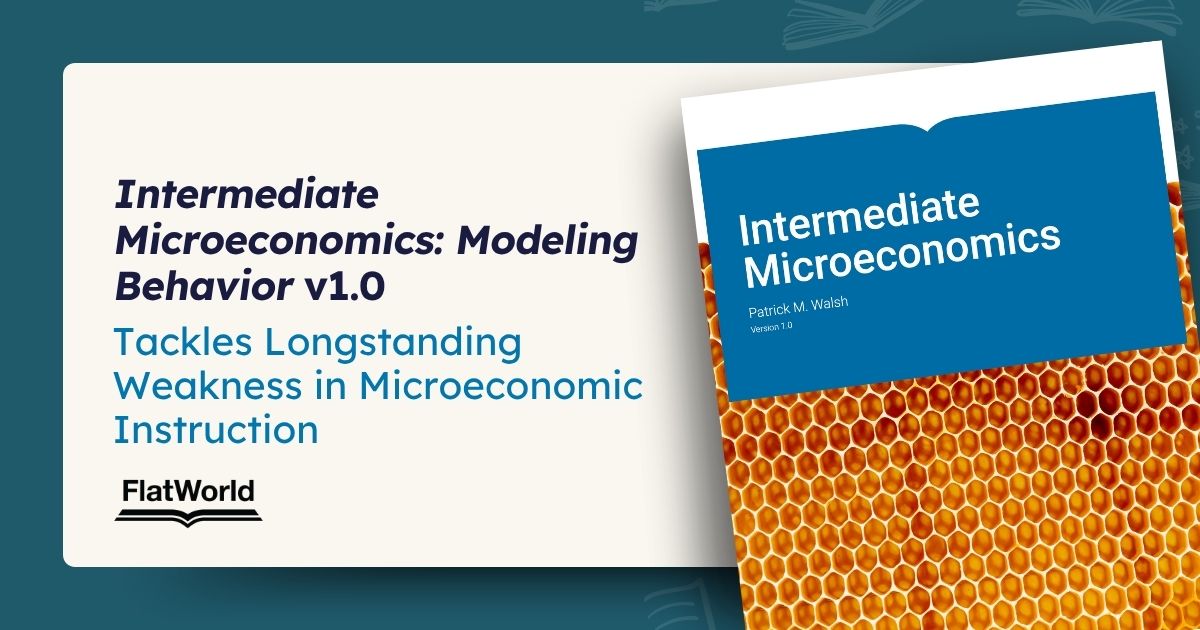
Author Dr. Patrick Walsh, Chair of the Department of Economics at Saint Michael’s College, has taught microeconomics for two decades and wrote this first edition to fundamentally change how the course is taught and assessed.
Intermediate micro has a reputation as one of the toughest courses in the economics major, for students and instructors alike, and Walsh traces the difficulty to what he characterizes as “a longstanding weakness in microeconomic instruction.”
The primary obstacle is grading: analytical work at this level is challenging to evaluate at scale.
Intermediate Microeconomics and the FlatWorld Homework system are designed to teach and assess the problem-solving most intermediate texts omit, regardless of classroom size.
The "Missing Middle" in Intermediate Microeconomics
Walsh calls the assessment gap the missing middle: the problem-solving that belongs between following a graph and manipulating a general-case equation.
For example, a student working a consumer problem starts with a utility function, combines it with a budget and prices, solves it, and then asks what changes when a price or an income moves.
Most intermediate texts leave out that analytical work, and the skills it builds.
Students who struggle with the math can get through the course, but, as Walsh writes, they “besiege the instructor for help,” returning to office hours again and again for the same routine problems. Students who are more proficient in the math, meanwhile, learn to plug values into formulas and leave “caught flat-footed by exams or graduate work that require context and flexibility.”
Adjusting the pace only trades one problem for the other. Whatever speed you choose, Walsh says, “you’re going to be boring the heck out of some students, and then there’s going to be other students who are just completely lost and drowning.”
Assessment That Grades Relationships Among Variables, at Any Class Size
Cloze Math in FlatWorld Homework makes the middle gradable. Your students move terms from numerator to denominator, flip them across the equals sign, and enter the relationship they arrive at. The system grades what they build automatically.
Walsh says the homework now asks a different question: “Can you actually generate the formula?” The result “doesn’t look like a numeric answer like 19,” he says. “It looks like several different variables in a particular arrangement.”
Walsh wrote the homework problems himself and class-tested them with his own students. Since the system does the grading, you can assign them as often as you like, whether your class holds 15 students or 150.
More Than 80 Explainer Videos, Produced by the Author
Walsh also produced every one of the more than 80 Khan Academy-style explainer videos that accompany the text, averaging about four per chapter.
Each video works a problem from beginning to end and flags the conceptual pitfalls where students reliably get stuck. Some concepts get two videos rather than one, working examples that don’t appear in the textbook, so students see the same approach applied to new problems.
The videos are automatically linked to the corresponding concepts in the text, so a student can pause, back up, and watch again until the concept lands.
Walsh built them to “complement, rather than substitute, the instructor,” and they reach students when the work is happening. As Walsh puts it, “if the student needs to rewatch a video three times at 2:00am in the morning, they can do that.”
Meeting Students Where They Are
The book gives students at different levels of math preparation for their own routes through the material.
The more gradual on-ramp begins in the narrative sections, where a bakery owner, a trio of college students, and a video game developer use microeconomic analysis to work out real decisions. For instance, in Chapter 3, the developer figures out how many toys and snacks will keep two toddlers content on a fixed budget, which introduces utility maximization before any equations appear.
The more direct route goes straight to the analytical work: side-by-side problems where a worked numeric example sits beside the same problem in general form, then the graphs and the homework.
What You'll Find Inside
Across 20 chapters, the book covers the conventional intermediate micro sequence and adds contemporary material on behavioral economics and portfolio theory. These features run throughout:
- More than 80 problem-solving videos, prepared and recorded by Walsh, give students step-by-step guidance through example problems at any hour.
- FlatWorld Homework problems written by Walsh, built on Cloze Math question types that take expressions and relationships among variables as answers, so you can assess how students reason at any class size.
- A mathematically rich approach that works with or without calculus, plus a highly intentional mix of graphical and quantitative analysis, with problem sets, examples, and solutions accuracy-checked by a qualified third party.
- Side-by-side presentations of each process, a specific example in one column and the general case in the other, and The Problem, a real-world scenario that opens each chapter and runs through it.
- Eyeball Derivatives, Context Maps, and Avoid Confusion notes that build intuition for what a derived function signifies, orient students to the process ahead, and compare equations that look similar at first glance.
What Reviewers Are Saying
Utteeyo Dasgupta of Fordham University:
“I quite liked the overall structure as well as the content and pedagogic innovations, such as the eyeball derivatives and S&G [specific and general] examples.”
Such pedagogic innovations recur through the chapters, each built for a specific point where students stall.
Other supportive learning features include Avoid Confusion notes, which set two near-identical equations against each other; chapter summaries, which work as checkpoints so a student can test what actually landed; and Context Maps, which lay out where a step sits in a longer problem, for the moment a student stops and asks, in Walsh’s words, “Wait, wait, where am I? What am I doing?”
Ron Cheung of Oberlin College:
“Intuitive, mathematically rigorous without being too dense.”
In practice, the math is rich enough for a program that requires calculus, and works in one that doesn’t.
What Students Gain
Here are the problem-solving skills students will gain from Intermediate Microeconomics: Modeling Behavior v1.0:
- Fluency in setting up a problem and solving it from beginning to end.
- The ability to reason through what happens when a price, a wage, or an income changes.
- Command of the mathematical mechanics, built with video support available whenever they study.
- The flexibility to handle a problem they haven't seen before.
All of it is built into the FlatWorld Engage platform: the Homework system, the explainer videos, the instructor supplements, and chapter-level customization, at a price that makes sense for your students.
We’ll take care of everything from there.